
Engineering
Load bank testing for yacht generators: what it is and when you need it
By Yachtgear.pro · Updated 2 October 2026
Written by our founder, a Y1 chief engineer with 16 years in yachting.
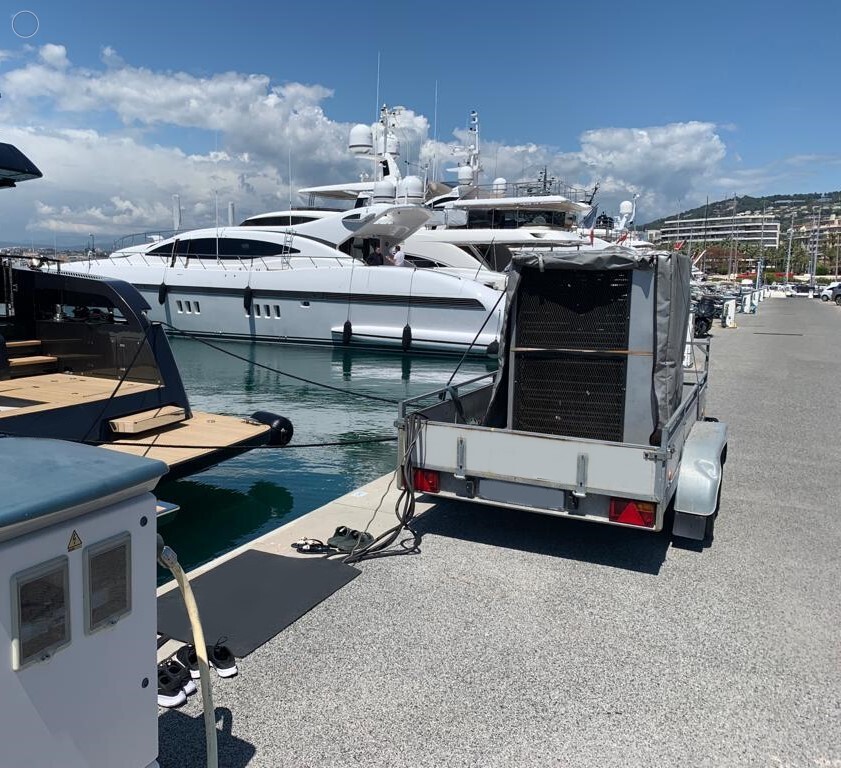
A load bank test puts a controlled electrical load on a yacht generator so you can prove it delivers full rated power, independently of what the ship is consuming. Test after an overhaul or major repair, before the season or a long passage, when a generator shows smoke, power or temperature problems, and whenever class, a survey or the manufacturer asks for it. Our 600 kW load bank rents for €850 per rental, VAT incl., with a €5,000 refundable deposit.
What is a load bank test?
A load bank is a controlled electrical load that you connect to the generator, so it can be run and measured at real power without relying on the ship’s own consumers.
On board, the load on a generator depends on whatever happens to be running: air conditioning, galley, stabilisers, pumps. That is rarely close to full rated power, and it changes all the time, so it tells you little about what the set can really deliver.
A load bank removes that uncertainty. It converts the generator’s output into heat in a controlled way, and the engineer sets exactly how much load is applied. You can bring the generator up to its rated output in known steps, hold it there, and record how the engine and alternator behave, all without touching the yacht’s distribution or putting guests and systems at risk.
Why do yacht generators need it?
Because yacht generators spend most of their lives at low load, and a test is the only reliable way to prove they can still deliver full power when you need it.
At anchor or in port, generators often run for long periods well below their rated output. Diesel engines don’t like that. Combustion temperatures stay low, fuel is not burned completely, and unburned fuel and soot collect in the exhaust and on injectors, valves and turbochargers. This is wet stacking, and it shows up as black or wet exhaust, oily deposits, carbon build-up and gradually falling performance.
A load bank test does two jobs. First, it proves the generator can carry full load with stable voltage and frequency, which is what matters on a passage when a second set trips or a big consumer starts. Second, running the engine at proper load raises temperatures and helps burn off deposits that light-load running has left behind.
When should you test?
After work on the generator, before demanding periods, when something looks wrong, and when you are required to.
- After an overhaul or major repair, to confirm the work before the generator goes back into service.
- Before the season or a long passage, so you know both sets can carry the yacht’s full load.
- When an engine shows smoke, loss of power, or temperature or pressure issues, to see how it behaves under real load and find the cause.
- When class, a survey or the manufacturer requires a load test, for example as part of a scheduled inspection or warranty.
Many chief engineers also add a load test to the yard period plan, since shipyard time is when generators are most often opened up and the yacht is least dependent on its own power.
How does a test work?
Connect, start at low load, increase in steps while holding and recording at each one, then reduce load and let the engine cool down.
- Connection. The load bank is connected to the generator output at a safe, isolated connection point, with the generator disconnected from the ship’s consumers as needed.
- Start and warm-up. The generator runs up to normal operating temperature at low load.
- Stepped load increases. Load is raised in steps towards the generator’s rated output, rather than all at once.
- Hold and record at each step. At every step, the engineer lets readings settle, then records voltage, frequency, exhaust and coolant temperatures, oil pressure and any other values the manufacturer or surveyor asks for.
- Full load. The generator is held at rated load long enough to show it is stable and to burn off deposits.
- Cool-down. Load is reduced in steps and the engine runs on without load to cool down before it is stopped and the load bank is disconnected.
How long each step lasts depends on the generator, its history and what class, the survey or the manufacturer requires. The recorded values become your evidence that the set performs as it should, and a baseline for the next test.
What do I need on board?
Access for the cables, a safe connection point, and an engineer to monitor the generator throughout.
- Access for the cables. Plan a route from the load bank on the quay or deck to the generator room. Our load bank comes with a 25-metre cable.
- A safe connection point at the generator output, where the load bank can be connected and isolated correctly.
- An engineer monitoring the generator for the whole test, watching temperatures, pressures and anything unusual.
What does it cost?
Our 600 kW load bank is €850 per rental, VAT incl., plus a €5,000 refundable deposit.
- Load bank rental, up to 600 kW: €850 per rental, including a 25-metre cable and remote control.
- Deposit: €5,000, fully refundable, released after the load bank is returned and inspected, normally within 7 days.
- Transport: €67 per hour of drive plus €0.85 per km, depending on the yacht’s location, invoiced separately after the job.
- Installation and monitoring: two engineers at €88 per hour per engineer, invoiced separately after the job.
See the full details on the load bank rental page, our engineering services, delivery areas on our ports page, and more answers in the FAQ.
Frequently asked questions
- How much does load bank testing cost on the French Riviera?
- Our 600 kW load bank is €850 per rental, VAT incl., plus a €5,000 refundable deposit. Transport (€67 per hour of drive plus €0.85 per km) and installation and monitoring (two engineers at €88 per hour each) are invoiced separately after the job.
- How often should yacht generators be load tested?
- Test after an overhaul or major repair, before the season or a long passage, when a generator shows smoke, power or temperature issues, and whenever class, a survey or the manufacturer requires it.
- Can you supply an engineer for the test?
- Yes. Installation and monitoring is carried out by two of our engineers, at €88 per hour per engineer, invoiced separately after the job.
- Do you deliver the load bank to the shipyard or marina?
- Yes. We bring it to the yacht. Transport is €67 per hour of drive plus €0.85 per km, depending on the yacht’s location, and is confirmed in your quotation.
- Is there a deposit?
- Yes, €5,000, fully refundable. It is released after the load bank is returned and inspected, normally within 7 days.